
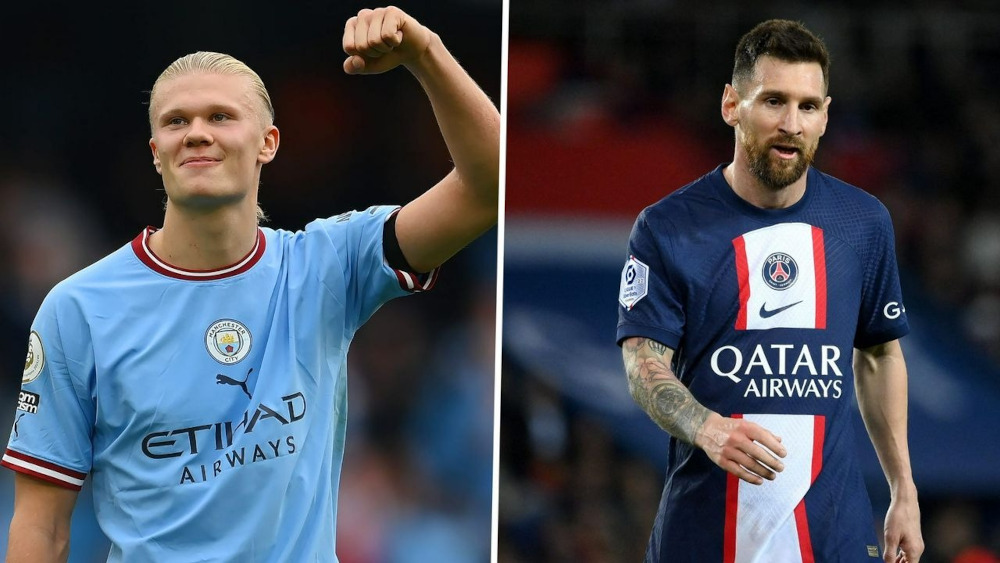
Haaland vs. Messi: The Ultimate Clash of Two Footballing Philosophies and a Statistical Comparison
If Cristiano Ronaldo is Haaland's "blueprint," then Messi represents almost the complete opposite.
Erling Haaland and Lionel Messi embody two radically different extremes of what a footballer can be:
- Haaland: A roughly 1.95-meter penalty-box predator, built around ruthless efficiency and the modern No. 9 in its purest form.
- Messi: A 1.70-meter footballing artist, defined by extraordinary technique and the ultimate expression of the free-roaming attacking player.
Which approach is more valuable? This article uses statistical evidence and tactical analysis to examine two generational superstars who have reached the highest levels of the game in completely different ways.
(Note: The core statistics in this article are compiled from major statistical platforms including FotMob, Transfermarkt, and UEFA, with data covering the end of the 2025/26 season and the 2026 World Cup.)
Core Statistical Comparison: Efficiency vs. All-Round Impact
Comparing players from different generations requires looking beyond a single statistic. Goals matter, but so do creation, tactical responsibility, longevity, and success at the highest level.
Career Overview (Through the End of the 2025/26 Season and 2026 World Cup)
| Comparison | Erling Haaland | Lionel Messi |
|---|---|---|
| Career competitive goals | 360+ | 920+ (second all-time) |
| Career goals per game | Approx. 0.84 | Approx. 0.79 |
| Career assists | 60+ | 400+ (according to major statistical databases) |
| Champions League goals | 57 | 129 (second all-time) |
| International goals | 62 (Norway record) | 120+ (Argentina record) |
| Best World Cup finish | Quarter-finals, 2026 | Winner, 2022 |
| Ballon d'Or awards | 0 (highest finish: 2nd) | 8 (all-time record) |
| Champions League titles | 1 | 4 |
| League titles | 3 Premier League | 10 La Liga + 2 Ligue 1 + 1 MLS |
Key takeaways:
- Haaland has the higher scoring rate (approximately 0.84 goals per game vs. 0.79).
- Major statistical databases show that Messi's assist numbers are vastly higher than Haaland's (400+ vs. 60+).
- The numbers highlight why comparing them purely statistically can be misleading: Haaland is primarily a finisher, while Messi combines creation and finishing at an extraordinary level.
Same-Age Comparison: Haaland's Goal-Scoring Explosion
If we rewind the clock and compare Haaland and Messi at 22, 23, 24, and 25, the contrast becomes particularly fascinating.
(Note: The figures below use cumulative statistics through the end of each age, including competitive club and international matches.)
| Age | Messi at the Same Age | Haaland at the Same Age |
|---|---|---|
| 22 | Already Barcelona's central figure and had won his first Ballon d'Or and Champions League title by 2009 | Had already reached the milestone of 200 competitive goals at the highest level |
| 23 | Had established himself among the world's best players while continuing to rewrite scoring and assist records | Completed the treble in 2022/23 and scored 52 goals, setting Manchester City's single-season scoring record |
| 24 | Entered one of the most dominant stretches of his career | Had established an extraordinary scoring rate in elite European competition |
| 25 | Scored an unprecedented 91 goals in the 2012 calendar year | Had become one of the most prolific centre-forwards in world football |
The takeaway:
- Haaland has scored at an extraordinary rate, while Messi's playmaking and creative influence were far beyond Haaland's at the same age.
- Messi's 91 goals in 2012 remain the record for most goals scored by a male player in a calendar year.
- Both players reached extraordinary levels for their age, but they did so in fundamentally different ways: Haaland is a goal-scoring machine, while Messi is a complete attacking playmaker and scorer.
Position and Role: Penalty-Box Predator vs. All-Pitch Playmaker
This is arguably the most fundamental difference between the two.
Haaland: The Ultimate Modern No. 9
- Position: Centre-forward
- Primary zones: Mostly operates in advanced areas and around the penalty box, relying on intelligent movement, runs in behind, and ruthless finishing.
- Primary responsibility: Finishing chances.
- Dependency: Relies heavily on his team's overall chance creation and quality service, but not necessarily on any single teammate.
- In one line: Haaland is the "man who waits for the chance."
Messi: Football's Ultimate Free-Roaming Attacker
- Position: Free-roaming attacker / playmaking forward, depending on the era — right winger, false nine, attacking midfielder, or right-sided creative hub.
- Primary zones: Depending on the tactical setup and stage of his career, Messi has operated from the wing, central areas, half-spaces, and even deeper midfield positions.
- Primary responsibility: Creation + scoring + progression.
- Dependency: Capable of creating opportunities for himself.
- In one line: Messi is the "man who creates the chance."
The fundamental difference: Haaland is more dependent on a system creating high-quality opportunities, whereas peak Messi could simultaneously carry the ball forward, create chances, and finish them himself. Haaland needs the system around him; Messi could become the system himself.
Technical Profiles: Power vs. Technique
Their technical profiles are almost mirror opposites.
Haaland's Skill Set
- ✅ Off-the-ball movement — elite, arguably historic
- ✅ Physicality — elite
- ✅ Shooting power and accuracy — world-class
- ✅ Aerial ability — excellent
- ⚠️ Dribbling — not his primary weapon
- ⚠️ Playmaking and chance creation — clearly not his main strength
- ❌ Free kicks — a relative weakness
Messi's Skill Set
- ✅ Dribbling — historic
- ✅ Passing and chance creation — historic
- ✅ Free kicks — historic
- ✅ Finishing accuracy — historic
- ✅ Balance and agility — historic
- ✅ Game intelligence — historic
- ⚠️ Heading — average
- ⚠️ Physical duels — limited by his size and not a defining strength
The conclusion: Their skill sets are almost complete opposites, representing two extremes of footballing ability.
Physical Profiles: Two Opposite Athletic Models
Haaland: The 1.95-Metre "Heavy Tank"
- Height: Approximately 1.95m
- Weight: Approximately 88kg
- Strengths: Power, speed, acceleration, aerial ability
- Weaknesses: Compared with low-centre-of-gravity attackers, he is less naturally suited to repeated changes of direction in extremely tight spaces.
Messi: The 1.70-Metre "Footballing Magician"
- Height: 1.70m
- Weight: Approximately 72kg
- Strengths: Low centre of gravity, balance, agility, acceleration, changes of direction
- Weaknesses: Aerial duels and long-distance sprinting
The comparison: This is one of the most extreme contrasts in physical profiles football has ever seen, yet both players have maximized the attributes they were given.
Tactical Value: System Finisher vs. System Creator
Haaland's Value
- Requires strong midfield support and a reliable supply of high-quality chances.
- His primary value lies in converting those chances into goals at an exceptional rate.
- He is the "finisher within the system."
- Best suited to possession-oriented teams with elite midfield creators.
Messi's Value
- Can create chances for himself as well as finish them.
- Can simultaneously contribute to chance creation, progression, final passes, and finishing.
- He is the "creator within the system."
- Extremely adaptable, capable of carrying a team's creative burden or operating primarily as a finisher.
The central question: Which type of value is greater?
- In the short term: Haaland — because his impact can translate directly into goals.
- Over the long term: Messi — because his all-round influence can elevate an entire attacking structure.
The 2026 World Cup: Two Footballing Philosophies Collide on the Biggest Stage
The 2026 World Cup in the United States, Canada, and Mexico brought these two contrasting footballing philosophies onto the biggest stage once again.
Haaland: Norway's Historic Breakthrough
- 7 goals: Haaland scored seven goals at the World Cup, establishing himself among the tournament's leading scorers.
- Norway reach the quarter-finals: He led the Norway national team to the quarter-finals for the first time in the country's World Cup history.
- Two goals against Brazil in the round of 16: Haaland scored twice against Brazil to help Norway secure a historic progression to the quarter-finals.
- Significance: Haaland demonstrated that he could also become a decisive figure for his country on football's biggest international stage.
Messi: Another Chapter in the Legend
- 21 World Cup goals: Messi scored eight goals at the 2026 World Cup, taking his career World Cup tally to 21 and moving into second place on the all-time World Cup scoring list.
- Argentina's attacking leader: At 39, Messi remained a major attacking focal point and a spiritual leader for Argentina.
- Significance: Messi showed that even in the final stage of his career, he could continue making history on the biggest stage.
The contrast: Haaland made history with Norway at 26, while Messi continued to add to his extraordinary legacy at 39. Both left their mark on the 2026 World Cup, but in very different ways.
Honours: A Nearly Impossible Gap to Bridge
Messi's Trophy Cabinet
- 8 Ballon d'Or awards — all-time record
- 1 World Cup — 2022
- 4 Champions League titles — 2006, 2009, 2011, 2015
Note: Messi was part of Barcelona's 2006 Champions League-winning squad but did not play in the final. - 10 La Liga + 2 Ligue 1 + 1 MLS titles
- 91 goals in a calendar year — 2012
- Copa América — 2021
Haaland's Honours
- 0 Ballon d'Or awards — highest finish: 2nd in 2023
- 0 World Cups — best finish: quarter-finals in 2026
- 1 Champions League — 2023
- 2 Premier League titles
- 3 Premier League Golden Boots
- Premier League single-season record of 36 goals
The conclusion: Messi's collection of individual and team honours represents an almost impossible benchmark, particularly the combination of eight Ballon d'Or awards and a World Cup.
What Can Haaland Learn from Messi?
Despite their radically different styles, there is still plenty Haaland can learn from Messi.
1. Technical Details
- First touch: Messi's control and first touch are virtually flawless.
- Close control in tight spaces: His ability to escape pressure in crowded areas is extraordinary.
- Free-kick technique: Messi is one of the greatest free-kick specialists in football history.
2. Reading the Game
- When to accelerate and when to slow down: Controlling the tempo of an attack.
- How to read defenders: Anticipating opponents' movements before they happen.
- How to create space: Not simply waiting for opportunities, but actively manufacturing them.
3. Longevity
- At 35, Messi led Argentina to the 2022 World Cup title and won the World Cup Golden Ball.
- Haaland will need to learn how to extend his peak and remain physically available over a long career.
4. All-Round Influence
- Don't just score goals — contribute to build-up play.
- Don't just finish chances — learn how to create them.
The Ultimate Verdict: Two Forms of Greatness That Resist Comparison
The Core Argument
Haaland and Messi are almost impossible to compare directly because they represent two extremes of the game:
- Messi is a "footballing artist"; Haaland is a "goal-scoring machine."
- Messi represents the ultimate free-roaming attacker; Haaland represents the ultimate pure No. 9.
- Both rank among the greatest players ever in their respective roles and styles.
Historical Standing
- Messi: Widely regarded as one of the greatest footballers in history and a near-universal first-tier candidate in debates over the greatest player of all time.
- Haaland: If he maintains his current scoring rate and continues accumulating major honours, he has the potential to enter the conversation among the greatest strikers in football history.
The One-Line Summary
Messi turned football into art; Haaland turned goalscoring into science.
FAQ: Haaland vs. Messi
Q: Who is better, Haaland or Messi?
A: They are extremely difficult to compare directly. Messi offers a more complete package of scoring and playmaking, while Haaland is more efficient as a pure goalscorer. In terms of overall ability and historical standing, Messi remains ahead.
Q: Can Haaland reach Messi's level?
A: It will be extremely difficult. Messi's eight Ballon d'Or awards and World Cup title represent a historic benchmark. Haaland would need to maintain an elite level for another decade while accumulating significantly more major honours.
Q: How are Haaland and Messi's playing styles different?
A: Haaland is a penalty-box predator and the archetypal modern No. 9, while Messi is a free-roaming attacker who can dominate the entire attacking phase. Haaland waits for opportunities; Messi creates them.
Q: Is Haaland the "next Messi"?
A: No. They are fundamentally different types of players. Haaland is a pure penalty-box finisher, while Messi is a complete attacking master capable of both creating and finishing chances. They represent two entirely different extremes of footballing excellence. Haaland does not need to become "the next Messi" — he only needs to become the best version of Haaland.
Q: Who has the greater historical legacy, Messi or Haaland?
A: Messi is widely regarded as one of the greatest footballers in history. Haaland still has time to build his legacy, but if he maintains his current level of efficiency, he has the potential to enter the discussion among the greatest strikers ever.
Q: Can Haaland ever surpass Messi's assist total?
A: It is extremely unlikely. Messi's 400+ assists are an extraordinary historical figure, while Haaland plays as a traditional No. 9 whose primary responsibility is finishing rather than creating.
Conclusion and Further Reading
Haaland and Messi represent two different extremes of footballing greatness. We are fortunate to have witnessed both.
Haaland does not need to become "the next Messi." He only needs to become the best version of himself. In his own unique way, he is already writing a chapter of football history that belongs to this generation.
(Data sources: FotMob, Transfermarkt, UEFA, and other major statistical platforms. Statistics cover the end of the 2025/26 season and the 2026 World Cup.)
Continue exploring Haaland's career and his comparisons with football's all-time greats:
- ⚔️ Haaland vs. Cristiano Ronaldo: The Ultimate Clash of Two Generational Goal Machines
- ⚔️ Haaland vs. Mbappé: Who Is the Best Player of the Post-Messi-Ronaldo Era?
- 📖 Erling Haaland: Complete Biography and Career Story
- 🧠 Haaland's Playing Style: How He Is Redefining the Modern Centre-Forward
- 📊 Erling Haaland Career Stats: Detailed Club and International Record