
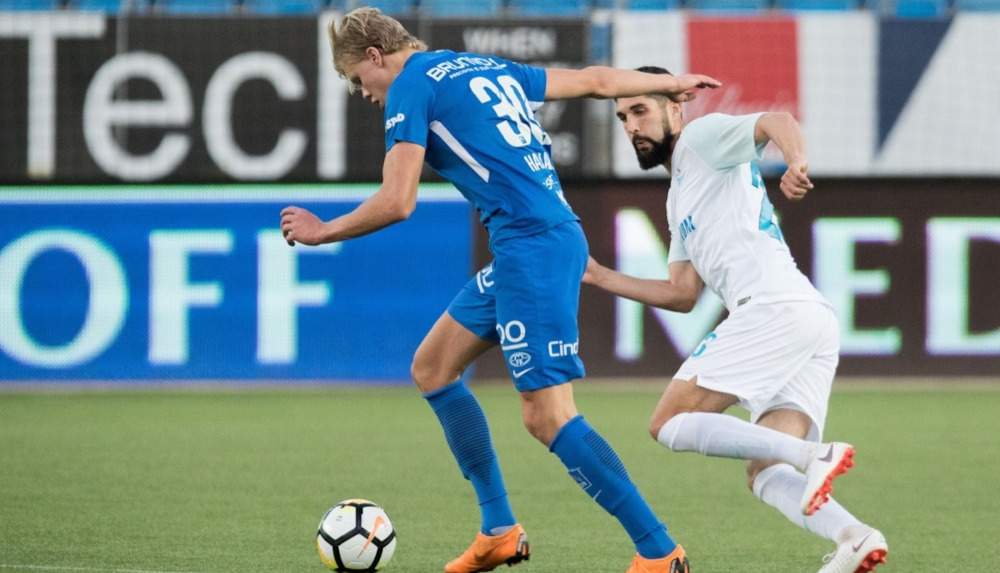
Erling Haaland's Molde Career: Solskjær's Guidance, Four-Goal Game, and Early Transformation
In February 2017, at just 16 years old, Erling Haaland left his hometown club Bryne FK and officially joined Norwegian top-flight side Molde FK.
It was one of the most important steps of his early career. At Bryne, Haaland had taken his first steps from academy football into senior competition. At Molde, however, he faced a significantly higher level of professional intensity, more sophisticated defensive systems, and greater tactical demands.
Even more importantly, he had the opportunity to work with Ole Gunnar Solskjær. The Manchester United legend and then-Molde manager became one of the most influential mentors of Haaland's early professional development.
During his two years at Molde, Haaland not only adapted to the demands of the Eliteserien but also produced a remarkable breakthrough in 2018. If Bryne provided the foundation for his footballing talent, Molde was where he truly began learning how to become a professional center-forward.
The Leap at 16: Why Molde Was the Perfect Stepping Stone
For 16-year-old Haaland, leaving his hometown and moving to Molde was a major step. In his 16 first-team appearances for Bryne, he had yet to score in the Norwegian second tier, although his remarkable goalscoring record for the reserve team had already demonstrated his potential.
However, success in youth football does not automatically translate into senior professional football.
Haaland did not need a comfortable environment where he could continue scoring with ease. He needed a professional setting that would force him to develop, and Molde provided exactly that:
- Higher-level training facilities and professional competition
- Regular opportunities to compete for first-team football in the Eliteserien
- Valuable experience in European competition
Most importantly, he would be working with a coach who understood the mentality and demands of an elite striker.
Solskjær's Coaching: From "Having Talent" to "Knowing How to Score"
Solskjær's own distinguished career as an elite goalscorer, particularly his legendary role as Manchester United's "super-sub," gave him a unique perspective as a coach.
He saw more than Haaland's height and speed. He recognized his exceptional hunger for goals, attacking instincts, and natural understanding of dangerous spaces around the penalty area.
Under Solskjær's guidance, Haaland made several important tactical and technical improvements:
-
Optimizing off-the-ball movement: He learned not to chase the ball aimlessly, but instead to attack weaknesses within defensive structures with greater purpose, understanding when to accelerate and when to make a second or delayed run.
-
Simplifying his finishing: Solskjær emphasized reducing unnecessary touches inside the penalty area. Haaland gradually developed the habit of making quick adjustments and finishing decisively, significantly improving his efficiency in front of goal.
-
Developing mental maturity: Solskjær helped the young striker build the resilience needed to deal with mistakes and pressure at a higher level, giving him greater confidence that he could consistently succeed in senior football.
Tactical and Physical Evolution: The Early Blueprint of a Modern Center-Forward
During his time at Molde, Haaland entered an important phase of physical development. His height, strength, speed, and explosiveness all improved significantly.
But his most dangerous quality was the way he combined these rapidly developing physical attributes with the spatial awareness he had already developed.
- Against high defensive lines: He could use his exceptional acceleration and top speed to burst into space behind the defense.
- Against compact defensive blocks: He began learning how to use his powerful core and physical strength to hold off defenders, protect the ball, and bring advancing teammates into play.
- Dynamic physical play: He could maintain his balance while running at high speed and still produce quality finishes after intense physical contact with defenders.
This combination of size, speed, hold-up ability, and explosive running represented an early blueprint of the modern all-around center-forward. It also laid the physical and tactical foundations for his subsequent success at Red Bull Salzburg and Borussia Dortmund.
The Breakthrough in 2018: Four Goals and European Scouting Attention
If 2017 was primarily a period of adaptation to the Eliteserien, 2018 was the year Haaland truly announced himself to the football world.
The Four-Goal Night Against Brann
On July 1, 2018, Molde faced Brann in the Eliteserien, and 18-year-old Haaland produced one of the defining performances of his early career.
He scored four goals in a single match, helping Molde secure a convincing victory.
The four goals showcased several elements of his developing attacking arsenal: explosive runs, intelligent movement inside the penalty area, and remarkable composure when presented with scoring opportunities.
The performance sent a powerful message to European football: this Norwegian teenager was no longer simply a promising domestic prospect. He possessed the tools to become a major attacking threat at the senior professional level and was increasingly attracting attention from scouts across Europe.
His First European Tests
As Haaland's performances in Norway continued to improve, he also gained experience in European competition, including Europa League qualifying matches.
Facing opponents from different countries and tactical backgrounds gave him an early opportunity to demonstrate that his qualities were not limited to Norwegian domestic football. His ability to adapt across different competitive environments helped pave the way for his subsequent move to Austrian powerhouse Red Bull Salzburg.
Haaland's Molde Career: Key Data and Timeline
During his relatively short spell at Molde, Haaland's development accelerated rapidly, taking him from a young fringe player to an increasingly important attacking option.
| Season | Competition / Stage | Key Performance and Milestone |
|---|---|---|
| 2017 | Norwegian top flight (Eliteserien) | Made his Eliteserien debut at 16 and scored his first top-flight goal, beginning his adaptation to senior professional football. |
| 2018 | Norwegian top flight | Enjoyed a major breakthrough, receiving significantly more playing time and becoming an important attacking player for Molde. |
| July 2018 | Eliteserien vs. Brann | Scored four goals in a single match, producing one of the most memorable individual performances of his early career and attracting widespread attention from European scouts. |
| 2018 | European competition, including Europa League qualifying | Gained his first significant experience in international club competition and demonstrated that his abilities could translate to a higher level. |
| Early 2019 | Transfer | Left Molde and completed his move to Red Bull Salzburg after developing his professional game in Norway. |
Note: Based on widely reported match statistics, Haaland made approximately 39 first-team appearances for Molde and scored 20 goals.
FAQ: Frequently Asked Questions About Haaland's Molde Career
Q: When did Haaland join Molde FK?
A: Haaland officially joined Molde FK in February 2017 at the age of 16, moving from his hometown club Bryne FK.
Q: How did Ole Gunnar Solskjær influence Haaland's career?
A: As a former elite striker and Molde manager, Solskjær gave Haaland regular opportunities to develop at senior level while helping him improve his off-the-ball movement, simplify his finishing, and develop the mental resilience required to perform consistently in professional football.
Q: When did Haaland score four goals for Molde?
A: On July 1, 2018, Haaland scored four goals for Molde against Brann in the Norwegian top flight. The performance became an important turning point in his early career and helped attract attention from major European clubs.
Q: Did Haaland win any trophies while playing for Molde?
A: Molde did not win the Eliteserien title during Haaland's time at the club. The most important aspect of his spell was his rapid individual development and transformation into a more complete professional striker.
Q: Why did Haaland leave Molde for Red Bull Salzburg?
A: As his performances in the Eliteserien and European qualifying matches attracted increasing attention, Haaland needed a platform offering a higher level of competition and a clearer pathway into European football. Red Bull Salzburg's strong reputation for developing young players and competing in European competition made it an ideal next step.
Q: What shirt number did Haaland wear at Molde?
A: Haaland initially wore the No. 30 shirt after joining Molde and continued to develop into an increasingly important attacking player for the club.
Conclusion: A Crucial Step on the Road to the Top
Looking back at Haaland's career, Molde FK played an irreplaceable role as an important development environment.
When he arrived at Molde at 16, he was still a raw young striker who relied heavily on instinct. Two years later, he had developed into a professional center-forward capable of using his physical strength, reading the game more effectively, and attacking scoring opportunities with an increasingly refined mentality.
His four-goal performance against Brann in 2018 was a crucial moment that helped bring him to the attention of the wider European football community.
If Bryne gave Haaland his love for football, Solskjær at Molde helped teach him how to approach the game with the standards and mindset of a professional striker.
Armed with that experience, Haaland embarked on the next stage of his journey in Austria, beginning the chapter that would ultimately lead him toward the summit of European football.
Continue Exploring Erling Haaland's Career:
- 📖 Erling Haaland Biography: His Complete Life and Career Story
- ⚽ Haaland at Bryne FK: The Starting Point of His Professional Career
- 🇦🇹 Haaland at Red Bull Salzburg: From Norwegian Prospect to European Breakout Star
- 🟡 Haaland at Borussia Dortmund: From Teenage Prodigy to World-Class Goalscorer
- 📊 Erling Haaland Career Statistics: Detailed Data