
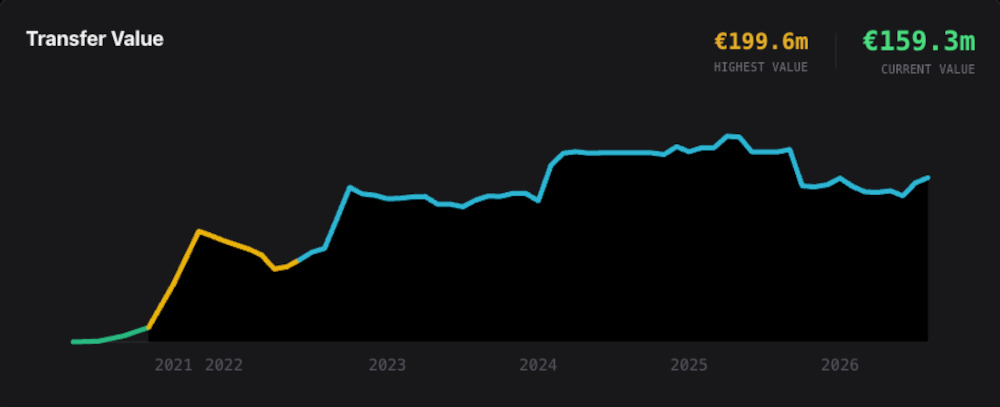
Erling Haaland Transfer History: Transfer Fees, Release Clauses & the Strategy Behind His Career Moves
Since bursting onto the European football scene, Erling Haaland's every major transfer has attracted enormous attention. Unlike many young prospects who rush to join the biggest club offering the biggest contract, Haaland's career path has followed a remarkably clear, calculated and forward-thinking step-by-step progression.
From his hometown club Bryne FK, to Molde FK, where he first made his mark in senior football, then to Red Bull Salzburg, where he exploded onto the Champions League stage, and Borussia Dortmund, where he established himself in one of Europe's top five leagues, Haaland eventually arrived at Manchester City ready to compete at the highest level.
Behind that progression were the strategic decisions of his father, Alf-Inge Håland, and the late super-agent Mino Raiola, whose approach to Haaland's career was based on choosing the right development environment at the right time.
This article breaks down the key transfers of Haaland's career, examining the reported transfer fees, release clauses and the sporting and commercial logic behind each move.
The First Big Step: Bryne to Molde (2017)
The Decision at 16: Why Leave Home?
At just 16 years old, Haaland made the first major move of his professional career in early 2017, leaving his hometown club Bryne FK to join Molde FK in the Norwegian top flight.
Bryne were playing in Norway's second tier at the time. Although Haaland had already shown extraordinary potential at youth and reserve level, he needed a more demanding competitive environment where he could regularly test himself against senior defenders.
Molde offered exactly that opportunity.
Solskjær's Call and the Transfer Details
The key figure behind the move was Ole Gunnar Solskjær, then manager of Molde. Solskjær had followed Haaland's development closely and pushed the club to sign the teenage striker.
- Transfer fee: Although Haaland was only 16, Molde reportedly paid around €100,000 (approximately NOK 500,000) to Bryne.
- Strategic significance: The move gave Haaland a pathway into regular senior football in Norway's top division. Under Solskjær's guidance, he began developing from a promising teenage talent into a professional goalscorer.
Heading to Europe: Molde to Red Bull Salzburg (2018–2019)
Raiola's Involvement and Salzburg's Scouting Network
In 2018, Haaland's performances for Molde — particularly his remarkable four-goal display against Brann — began attracting serious attention from clubs across Europe.
Around this time, one of football's most influential agents, Mino Raiola, became increasingly involved in Haaland's career planning.
Rather than rushing an 18-year-old striker straight into a major European league where he might struggle for regular playing time, Haaland's team looked for a club that could provide elite competition, Champions League exposure and the right tactical environment.
Red Bull Salzburg's scouting network and development model made them an ideal fit.
Signing First, Joining Later
- Transfer details: In August 2018, Salzburg reached an agreement with Molde for Haaland. To ensure a smooth transition, he remained at Molde for the rest of the 2018 season before officially moving to Austria in January 2019.
- Transfer fee: Salzburg reportedly paid around €8 million for the striker.
- Strategic significance: The move allowed Haaland to adapt to European football without immediately being burdened by the expectations surrounding a major transfer. It also gave him a platform to announce himself on the Champions League stage.
Breaking Into Europe's Top Five Leagues: Salzburg to Borussia Dortmund (2020)
The Bidding War After His Champions League Explosion
During the second half of 2019, Haaland became one of the most sought-after young players in European football.
He scored eight goals in six Champions League group-stage appearances, attracting interest from some of the continent's biggest clubs, including Manchester United, Juventus and Real Madrid.
Why Dortmund? Why the January Transfer Window?
Despite interest from major European clubs, Haaland and his representatives remained remarkably calculated. Rather than simply choosing the biggest name, they prioritized a club that could offer him an important role and a clear pathway to becoming a first-choice striker.
Borussia Dortmund emerged as the ideal destination.
- Release clause strategy: When Haaland signed for Salzburg in 2018, his contract reportedly included a release clause that could be activated in January 2020 for around €20 million. Some reports suggested the overall package could reach approximately €30 million once additional costs were included.
- Transfer fee: In December 2019, Dortmund announced the signing, with the widely reported base fee standing at around €20 million, plus potential bonuses of up to €10 million.
- Strategic significance: Dortmund offered Haaland an immediate starring role, Champions League football and the opportunity to establish himself in one of Europe's most competitive leagues.
The move proved decisive. Haaland quickly transformed from one of Europe's most exciting prospects into a genuine world-class striker.
The Blockbuster Move: Borussia Dortmund to Manchester City (2022)
The Long Wait and the Transfer Battle
During the summer of 2021, Dortmund were determined to keep Haaland for another season. Manchester City, meanwhile, continued to monitor the situation after failing to sign Harry Kane.
Over the following year, Real Madrid, Barcelona, Paris Saint-Germain, Manchester United and Manchester City were all linked with the striker.
The race for Haaland became one of the defining transfer sagas of the period.
Guardiola's Adaptation and City's Ambition
Ultimately, Pep Guardiola made a major adjustment to his usual preference for fluid attacking systems without a traditional No. 9, with Manchester City committing to building a system around Haaland's elite finishing and physical presence.
- Release clause: Haaland's Dortmund contract reportedly contained a future release mechanism that allowed him to leave for a predetermined fee.
- Transfer fee: In the summer of 2022, Manchester City activated the clause and paid Dortmund a reported €60 million base fee.
- Strategic significance: This was the biggest step of Haaland's career. He had finally reached the Premier League's biggest stage and joined a team built to compete for domestic and European trophies.
In his debut season, Haaland helped Manchester City complete a historic treble, immediately establishing himself as one of the most dominant strikers in world football.
The "Step-by-Step" Strategy Behind Haaland's Transfers
Looking back at Haaland's transfer history, a clear philosophy emerges: don't rush the process — choose the right environment for continuous development.
1. Avoiding the Wrong Kind of Competition
At several crucial points in his career, Haaland's representatives prioritized regular first-team football over the prestige of joining the biggest possible club.
The goal was not simply to move upward as quickly as possible, but to ensure that every step provided the playing time, tactical responsibility and competitive level he needed at that particular stage of his development.
2. The Power of Release Clauses
Release clauses became one of the defining features of Haaland's transfer strategy.
By negotiating predetermined exit mechanisms into his contracts, Haaland's camp maintained greater control over when and how he could move.
For buying clubs such as Dortmund and Manchester City, these clauses also provided greater cost certainty and reduced the risk of prolonged transfer negotiations.
This approach gave Haaland a rare degree of leverage for a young player while allowing his career to progress on carefully chosen terms.
Erling Haaland Transfer History at a Glance
As of 2026, Haaland's major career transfers can be summarized as follows:
| Transfer Date | From | To | Reported Fee | Key Clause / Background |
|---|---|---|---|---|
| February 2017 | Bryne FK | Molde FK | Around €100,000 | Left his hometown club at 16 to pursue regular top-flight football. |
| January 2019 | Molde FK | Red Bull Salzburg | Around €8 million | Agreement reached in August 2018; officially joined Salzburg in January 2019. |
| January 2020 | Red Bull Salzburg | Borussia Dortmund | Around €20 million | Dortmund activated the reported January release clause. |
| July 2022 | Borussia Dortmund | Manchester City | Around €60 million | Manchester City activated the reported release clause and brought him to the Premier League. |
FAQ: Erling Haaland's Transfer History
Q: How much did Manchester City pay for Erling Haaland?
A: In the summer of 2022, Manchester City activated the release clause in Haaland's Dortmund contract and paid a reported €60 million (around £51 million) in base transfer fees.
Q: Did Erling Haaland have a release clause at Borussia Dortmund?
A: Yes. Haaland's Dortmund contract reportedly included a release clause that became active in 2022. Manchester City used that mechanism to sign him for a reported fee of around €60 million.
Q: Why didn't Haaland join Manchester City in the summer of 2021?
A: Dortmund were determined to keep their star striker for another season, while Haaland's camp also had strong reasons to continue his development at Dortmund before making the next major move. The eventual transfer therefore took place in 2022.
Q: Who was responsible for Haaland's transfers?
A: Haaland's early career moves were heavily influenced by the late super-agent Mino Raiola and his representatives, working alongside Haaland's father, Alf-Inge. After Raiola died in April 2022, his longtime associate Rafaela Pimenta took over Haaland's representation and continued handling his contractual and commercial affairs.
Q: How much did Borussia Dortmund pay for Haaland?
A: In January 2020, Dortmund activated the reported release clause in Haaland's Salzburg contract and paid around €20 million in base transfer fees, with additional bonuses reportedly taking the total package higher.
Conclusion: A Masterclass in Career Planning
Erling Haaland's transfer history is a fascinating case study in modern football career management.
Rather than being distracted by the biggest possible salary or the prestige of joining a global superclub too early, Haaland followed a carefully structured path through Molde, Salzburg and Dortmund, gaining the tactical experience, physical maturity and mental resilience required at each stage.
By the time he walked onto the pitch at the Etihad Stadium in the summer of 2022, he was not simply another highly rated young striker. He arrived as a player who had already been carefully prepared for the highest level of European football.
That may ultimately be the most valuable lesson from Haaland's transfer strategy: the best career move is not always the biggest move available — it is the move that puts a player in the best position to succeed.
Continue exploring Erling Haaland's career:
- 📖 Erling Haaland Biography: His Life, Career and Rise to Stardom
- 🏆 Erling Haaland Records & Achievements: The Record-Breaking Striker
- 🏅 Erling Haaland Trophies & Honours: From Domestic Cups to Champions League Glory
- 📊 Erling Haaland Career Stats: Goals, Appearances and Records
- 🔵 Erling Haaland at Manchester City: From Superstar Striker to Title-Winning Core